



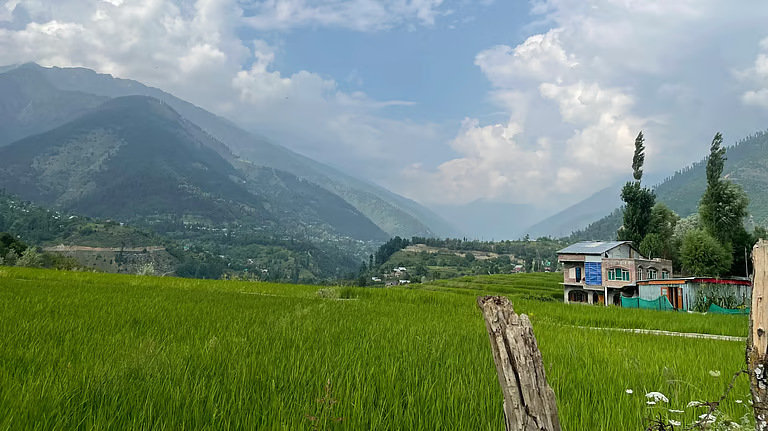
Srinagar, Oct 13: Agricultural land in Kashmir is facing mounting pressure from urban expansion, construction and changing land-use patterns, with recent research documenting a substantial decline in farmland around Srinagar and official government figures showing a fall in the net sown area across Jammu and Kashmir.
A satellite-based study published in the journal ‘City and Built Environment’ in March 2026 found that the area classified as agricultural land within its mapped Srinagar study area declined from approximately 14,230 hectares in 1992 to 6,589 hectares in 2024, representing a reduction of about 7,641 hectares, or 53.7 per cent.
The findings point to a major transformation of the landscape around Srinagar over more than three decades, although the study’s figures relate to its mapped study area and should not be interpreted as a measurement of agricultural land loss across the entire Kashmir Valley.
The pressure on farmland is also reflected in a separate peer-reviewed study examining land-use changes in the central Kashmir Valley. Using satellite imagery, the researchers found that the proportion of the study area classified as agricultural land fell from 55.77 per cent in 1992 to 39.68 per cent in 2015.
The study identified urban expansion and the conversion of paddy fields into horticultural land among the factors contributing to the changing agricultural landscape. Its findings, however, cover a defined part of the Valley rather than all districts of Kashmir.
The official figures present a further indication of the pressure on cultivated land. According to the Jammu and Kashmir Economic Survey 2025-26, the Union Territory’s net area sown declined from 738,030 hectares in 2023-24 to 729,000 hectares in 2024-25, a reduction of 9,030 hectares, or approximately 1.2 per cent in one year.
The figures as per the news agency Kashmir News Trust’ cover both Kashmir and Jammu divisions and do not establish how much of the decline occurred specifically in the Kashmir Valley. Nevertheless, they highlight the need for district-wise data to determine the scale and geographical distribution of the change.
Urbanization is among the major concerns identified in research on land-use changes around Srinagar. As residential colonies, commercial establishments, roads and other infrastructure expand, agricultural land on the urban fringe faces increasing competition from non-agricultural uses.
The conversion of paddy fields into orchards also complicates the assessment of agricultural land loss. Although such a change can reduce the area classified specifically as cultivated cropland or paddy land, the converted land may continue to serve an agricultural purpose. A distinction must therefore be made between changes in the type of cultivation and the permanent loss of agricultural land to construction.
The distinction is important for assessing the long-term implications for Kashmir’s food production, rural livelihoods and land-use planning. Paddy cultivation remains an important part of the Valley’s agricultural economy, while horticulture provides income to a large number of farming households. The permanent conversion of productive land into built-up areas is different from a shift between agricultural activities and requires separate measurement.
The Jammu and Kashmir Government has a legal framework governing the conversion of agricultural land for non-agricultural purposes. In March 2025, Chief Minister Omar Abdullah informed the Legislative Assembly that Section 133-A of the J&K Land Revenue Act regulates such conversion and requires the prescribed permission from the competent authority, including the District Collector, as applicable.
The existence of these restrictions, however, does not by itself establish the extent to which they have prevented the loss of agricultural land. A comprehensive assessment would require details of conversion permissions, violations, enforcement proceedings and the amount of land restored or protected under the applicable laws.
District-wise records could help establish whether farmland is disappearing most rapidly around Srinagar and its adjoining urban areas or whether similar patterns are emerging in other parts of the Valley. Comparing historical land-use maps with current revenue records would also help distinguish agricultural land converted into buildings from fields that have become fallow or shifted to horticulture.
The available research and government statistics indicate that agricultural land-use change is a significant issue requiring closer examination. However, they do not provide a single, comparable estimate of the total agricultural land permanently lost across the entire Kashmir Valley over a common period. [KNT]